
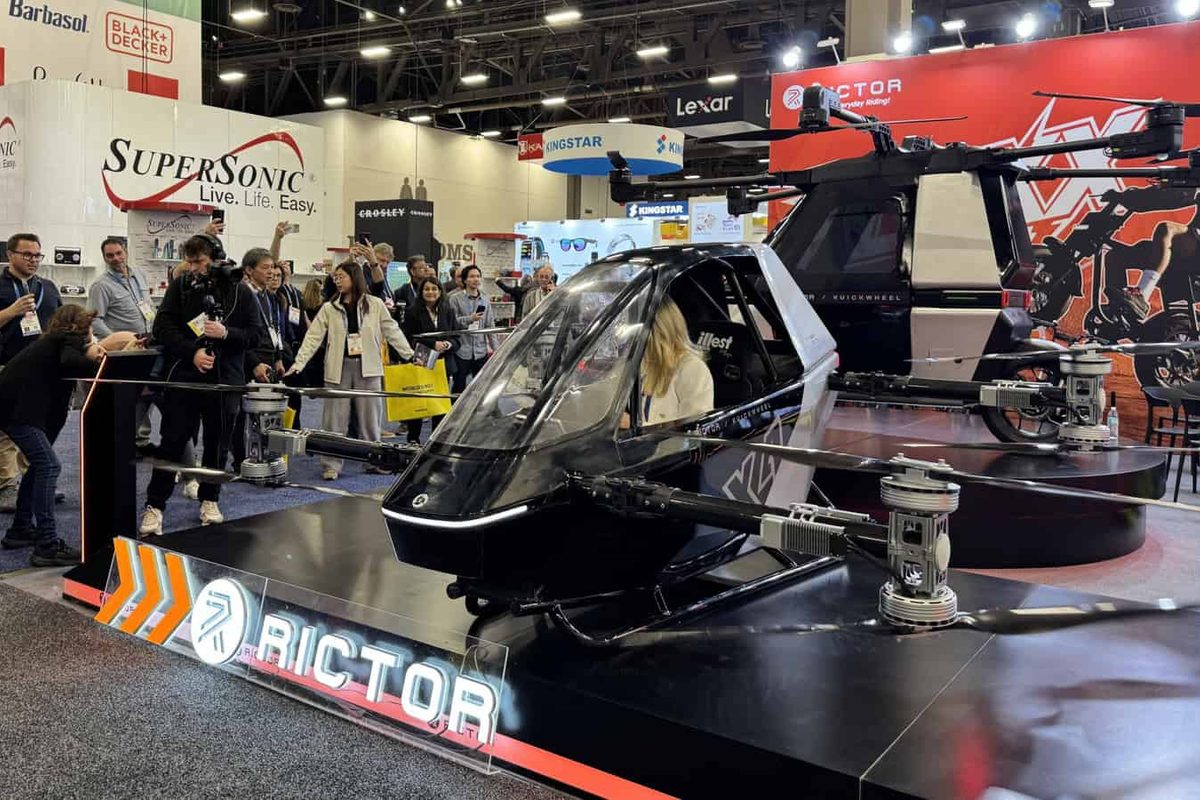
The RICTOR X4 Air Mobility Pod launched at CES 2026 with a $39,900 price tag, FAA Part 103 compliance, and no pilot's license required. First deliveries are scheduled for Q2 2026.
Flying your own aircraft has always meant serious money and serious training. Most personal aircraft start well into six figures. The RICTOR X4 cuts through that. Launched at CES 2026 in Las Vegas, this single-seat ultralight eVTOL (electric vertical take-off and landing aircraft) carries a launch price of $39,900, with a $5,000 deposit to secure your spot.
The X4 qualifies under FAA Part 103 ultralight regulations, which means anyone can operate it legally in the US without a pilot's license or airworthiness certification. That is the same regulatory classification used for ultralight fixed-wing planes and powered hang gliders. The X4 just takes off and lands vertically, tops out at 80 km/h (50 mph), and can fly as low as 3 meters above the ground, well within the Part 103 low-altitude envelope.
What makes this credible is the engineering depth behind it. RICTOR operates under parent company Kuickwheel Technology, a Chinese smart mobility firm with a track record building connected electric bikes and scooters since 2014. The company holds nearly 500 patents and exports products to over 80 countries. The X4 is their first aircraft, built on that foundation.

Eight Motors, One Pilot, No License
The X4 runs on a 4-axis, 8-propeller configuration. Each axis generates up to 132 kg (291 lb) of thrust, well above what the aircraft needs to carry its 100 kg (220 lb) maximum payload, pilot included. The 63-inch carbon-fiber propellers fold flat when not in use, collapsing the entire aircraft to 1.2 cubic meters. That fits in the bed of a standard pickup truck.
Noise has been kept under 65 decibels, roughly the level of a normal conversation or a passenger car going by. RICTOR's proprietary Dynamic Balance Algorithm adjusts all eight motors in real time to hold a stable hover, even in side winds up to Level 6. The result is a vehicle that flies predictably without requiring a trained hand at the controls.
Flight time is 20 minutes per battery. Top speed is 80 km/h (50 mph). Those numbers will not replace a helicopter, and the X4 was built for different missions entirely. This is personal aerial mobility for short hops: urban commutes, property access, getting from A to B without ground traffic in the way.
Safety Built In, Not Bolted On
The X4 runs a semi-solid-state battery pack with dual-battery redundancy. One module can fail and the aircraft still lands safely. An emergency parachute system covers the worst-case scenario on top of that.
Operators can choose between manual control and pre-programmed route modes. The autonomous route option lets the X4 follow programmed flight paths at very low altitudes, including as low as 3 meters above ground, which makes it practical for urban corridors, private property, and situations where hands-free operation is the right call.
The battery tops up in-vehicle; plug in while parked or driving and the X4 is ready for the next trip. When you get there, unfold the props and fly. RICTOR describes this as "fly anywhere, anytime," and the portability specs back it up.
How the Price Gets This Low
RICTOR's closest comparison in the personal eVTOL space is the Jetson One, which retails at $128,000. The X4 at $39,900 costs under a third of that. At the CES launch, the CEO of Kuickwheel Technology stated that RICTOR's goal is to open "a completely new, accessible market for 'light aerial mobility'" rather than competing in the complex manned aviation sector.
The ability to price aggressively comes from years of manufacturing electric micro-mobility products at scale. RICTOR's core KL.tech Expert System integrates seven proprietary technologies, including FOC motor vector control, gyroscope attitude control, and intelligent battery management. That is industrial-grade engineering at consumer pricing. The company's supply chain spans over 80 countries, and nearly 500 patents back its technical foundation.

What to Know Before You Order
This is a single-seat, single-mission aircraft. The 100 kg payload cap means the operator and any gear need to stay light. Flight time is 20 minutes per battery, so trip planning around energy capacity matters.
FAA Part 103 also comes with operating constraints. Legal flight in the US requires daytime conditions, uncongested airspace, speeds under 55 mph, and altitudes under 500 feet above ground level. Busy airspace near airports requires prior coordination. The X4's autonomous low-altitude mode was built around exactly these parameters.
First deliveries are scheduled for Q2 2026, with a $39,900 launch price and $5,000 deposit required. One note worth tracking: RICTOR also presented a flying motorcycle concept at CES 2025; that product has not reached production, so buyers should watch the Q2 timeline with realistic expectations.
Frequently Asked Questions
Do I need a pilot's license to fly the RICTOR X4? No. The X4 qualifies as an ultralight aircraft under FAA Part 103 regulations. This classification allows legal operation in the US without a pilot's license or airworthiness certification. Part 103 requires daytime-only flight, uncongested airspace, airspeed under 55 mph, and altitude under 500 feet AGL.
How much does the RICTOR X4 cost? The X4 launched at $39,900 with a $5,000 deposit required to place an order. RICTOR has targeted Q2 2026 for first deliveries.
How long can the X4 fly on one battery? The X4 has a rated flight time of approximately 20 minutes per battery. A semi-solid-state dual-battery system provides redundancy, so a single module failure still allows a controlled, safe landing.
Can the X4 fly autonomously? Yes. The X4 supports pre-programmed route modes, letting it follow programmed flight paths autonomously at very low altitudes, including as low as 3 meters above ground. Manual control remains an option throughout.
How compact is the RICTOR X4 when folded? With the carbon-fiber propeller arms folded, the X4 collapses to 1.2 cubic meters, small enough to transport in the bed of a standard pickup truck and top up in-vehicle while driving.
Who makes the RICTOR X4? RICTOR is a brand under Kuickwheel Technology, a Chinese smart mobility company founded in 2014. Kuickwheel holds nearly 500 patents and exports electric bikes and scooters to over 80 countries. The X4 is RICTOR's first aircraft product.
How does the X4 compare to the Jetson One? The Jetson One is the primary comparable personal eVTOL and retails at $128,000. The X4 at $39,900 costs roughly 69% less, with similar single-seat, ultralight positioning. The Jetson One has a longer production track record; the X4 has yet to ship to customers as of April 2026.
Images: Rictor

Leave a comment
This site is protected by hCaptcha and the hCaptcha Privacy Policy and Terms of Service apply.