
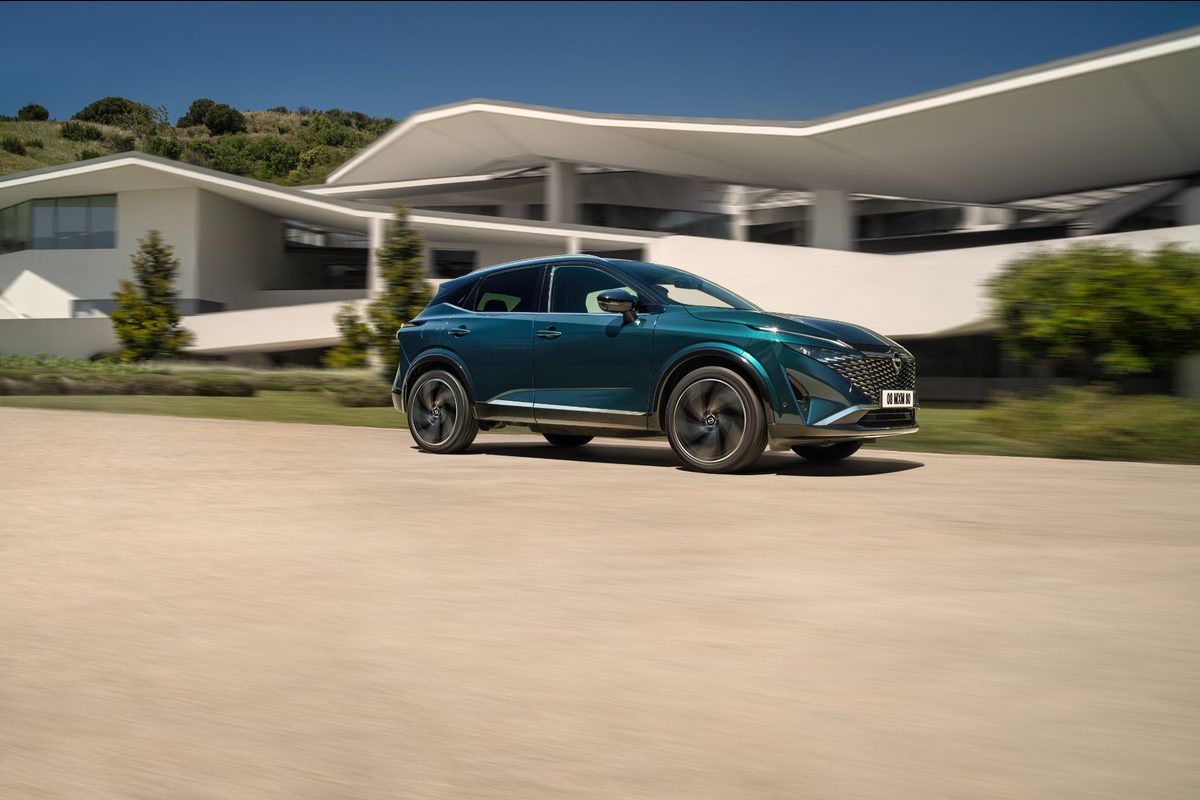
The company has spent nearly a decade perfecting this technology. Now the US finally gets it.
Nissan is having a moment with hybrids that most people haven't fully noticed yet. While the automotive conversation has been dominated by fully electric vehicles and the brands rushing to build them, Nissan has been quietly building something different. It's a hybrid system that 1.6 million people in 70 countries already rely on, and it's finally arriving in the United States in 2026.
Two models. Two different approaches. One very clear signal about where Nissan is headed.

Two Hybrids, Two Very Different Stories
Before getting into why the technology is genuinely worth paying attention to, it helps to understand what Nissan is actually putting on the market this year.
The first vehicle is the 2026 Nissan Rogue Plug-in Hybrid, which is already arriving at dealerships. It's Nissan's first plug-in hybrid in the US market, delivering 248 horsepower, 332 lb-ft of torque, up to 38 miles of all-electric driving range, and a total range of 420 miles. A full charge takes 7.5 hours on a Level 2 home charger. It seats seven, comes standard with intelligent AWD, and starts at $45,990. Reviewers have been largely positive about the driving experience, and the numbers are competitive.
There is one thing worth knowing upfront: the 2026 Rogue PHEV is essentially a rebadged Mitsubishi Outlander PHEV, developed jointly between the two companies as part of the Renault-Nissan-Mitsubishi Alliance. Nissan didn't hide this. They needed a plug-in hybrid on the market now, while the US hybrid wave is surging, and they used the most sensible tool available to get there quickly. It's a strategic placeholder that happens to be a legitimately good family SUV.
The real story, though, is what arrives next.

Meet the 2027 Rogue Hybrid e-POWER: The One Nissan Actually Built From the Ground Up
The 2027 Nissan Rogue Hybrid e-POWER, set to arrive in October 2026, brings a fundamentally different approach to hybrid engineering to the US market.
In every conventional hybrid you've ever driven, including the Toyota RAV4 Hybrid and the Honda CR-V Hybrid, the gasoline engine has two jobs: it can generate electricity AND directly drive the wheels, depending on conditions. Those systems toggle between modes constantly, which is why you sometimes feel a subtle shift in the character of the power delivery.
The e-Power system removes that entirely. With e-Power, the gasoline engine never touches the wheels. It has one job: generate electricity. An electric motor, powered by that electricity, does all the actual driving. Always.
The result is a driving experience that reviewers who have tested the equivalent European model describe as genuinely EV-like: instant torque, smooth and quiet low-speed operation, linear power delivery, no gear hunting. Ponz Pandikuthira, Nissan's Senior Vice President and Chief Planning Officer, stated: "It will match what you see from a RAV4 or a CR-V with a far better driving experience."
The technology backs it up. The electric motor powering the wheels is the same type of unit found in a purpose-built EV. The difference is simply that instead of a large battery pack, you have a small 2.1 kWh battery and an engine that keeps it topped up as you drive.

The Engineering Behind It
The engine powering the e-Power generator is a new 1.5-liter three-cylinder turbocharged unit developed specifically for this application, with a thermal efficiency of 42%. Most naturally aspirated production engines operate in the 35 to 38% thermal efficiency range. At 42%, Nissan is extracting an unusually high proportion of energy from each drop of fuel, which is how the system achieves competitive efficiency even without a large battery.
Crucially, because the engine only needs to run at its optimal RPM to generate power, it doesn't have to respond to driving demands the way a conventional engine does. That means fewer vibrations, quieter operation, and more consistent performance. Nissan's engineers have worked on this for three generations across the product's history, and the refinement shows.
The US version of the Rogue Hybrid e-POWER will also add a second electric motor on the rear axle, delivering all-wheel drive as standard. The European version of the platform is front-drive only. Americans get the upgraded configuration from day one.
For fuel economy, Nissan is targeting parity with the best in class. The Toyota RAV4 Hybrid earns up to 41 mpg combined. The Honda CR-V Hybrid gets up to 40 mpg combined. Nissan has confirmed the e-Power Rogue is being engineered to compete directly with those numbers, with some test results on comparable European models suggesting 38 to 40 mpg is well within reach under US driving conditions.
The system packages its motor, generator, inverter, reducer, and power increaser into a single modular unit, keeping the powertrain compact and leaving meaningful room in the vehicle for passengers and cargo.

Why the Timing Is Right
There is a broader context here that makes Nissan's hybrid push particularly well-timed. S&P Global Mobility projects that hybrid vehicles will represent 18.4% of US new car sales this year. Three years ago, that figure was 7.3%. Meanwhile, fully electric vehicle sales are tracking at 7.1%, slightly below where they were in 2024.
The market is telling the industry something clear: buyers want efficiency and they want electrified powertrains, but on their own terms. They want to fill up with gas when they need to and drive without calculating charge stops. The e-Power system is almost a direct engineering response to that signal. No plug required. No range anxiety. Just the efficiency of electric drive and the convenience of a gas tank.
Nissan's Hybrid e-POWER technology has already proven this commercially at scale. More than 1.6 million vehicles across 70 countries have been sold with this system since it launched in Japan in 2017. That indicates it's a mature product that Nissan has refined over three generations specifically to meet the expectations of a demanding new market.
Kurt Rosolowsky, a Vehicle Evaluation and Test Engineer at Nissan, was direct about the ambition, "We're not bringing it to the market because we just see it as a niche powertrain." The company sees this as a mainstream offering, priced to compete with the best-selling hybrids in the segment at an expected starting price of under $35,000.

What to Expect in Showrooms
The 2026 Rogue Plug-in Hybrid is at dealerships now, in SL and Platinum trims at $45,990 and $49,990 respectively. For buyers who want Nissan's first hybrid option today, it's a well-equipped, capable seven-passenger SUV with meaningful EV range for daily driving and no range anxiety for longer trips.
The 2027 Rogue Hybrid e-POWER is coming in October 2026, alongside a full redesign of the Rogue that draws design inspiration from the new Nissan Armada and Murano. Expect a wider, more angular front end, illuminated Nissan badging, and an interior anchored by dual 12.3-inch screens. It will be priced well below the PHEV, targeting the heart of the compact SUV segment rather than the premium end.
After the Rogue, Nissan has confirmed that e-Power is coming to more models. The next-generation Kicks is widely expected to be next in line, which would make it a direct challenger to the Toyota Corolla Cross Hybrid. Reports also point to potential e-Power availability in the Pathfinder and Murano.
Nissan is building a hybrid ecosystem, not just launching a single model.

The Bottom Line
The 2027 Nissan Rogue Hybrid e-POWER deserves more attention than it's currently getting. It's a car built on a decade of global development, aimed directly at the most competitive and fastest-growing segment in the US market, with a driving experience that reviewers who have already tested its European equivalent describe as genuinely distinct from anything Toyota or Honda currently offers.
The 2026 Rogue PHEV bridges the gap until October. It's a capable product that gives Nissan a hybrid entry right now, when buyers are actively shopping that segment in record numbers.
Together, these two vehicles represent Nissan's most significant US product initiative in years, and both of them are pointed squarely at the right part of the market at the right time.

Frequently Asked Questions
What is Nissan e-Power and how is it different from a regular hybrid? In a regular hybrid, the gasoline engine can directly drive the wheels. With e-Power, the engine only generates electricity. An electric motor drives the wheels at all times, delivering an EV-like experience without the need to plug in.
When does the 2027 Nissan Rogue Hybrid e-POWER go on sale? Nissan is targeting an October 2026 launch for the 2027 Rogue Hybrid e-POWER in the US and Canada.
How much will the 2027 Nissan Rogue e-POWER cost? Pricing has not been officially announced, but Nissan has indicated it will start under $35,000, below the 2026 Rogue PHEV which starts at $45,990.
Do you need to plug in the Nissan e-Power? No. The e-Power system uses a very small 2.1 kWh battery that is charged by the onboard gasoline engine. There is no external charging required.
How fuel-efficient is the 2027 Nissan Rogue Hybrid e-POWER? Nissan is targeting fuel economy that matches the Toyota RAV4 Hybrid and Honda CR-V Hybrid, with EPA estimates expected around 38 to 40 mpg combined.
Images: Nissan

Leave a comment
This site is protected by hCaptcha and the hCaptcha Privacy Policy and Terms of Service apply.